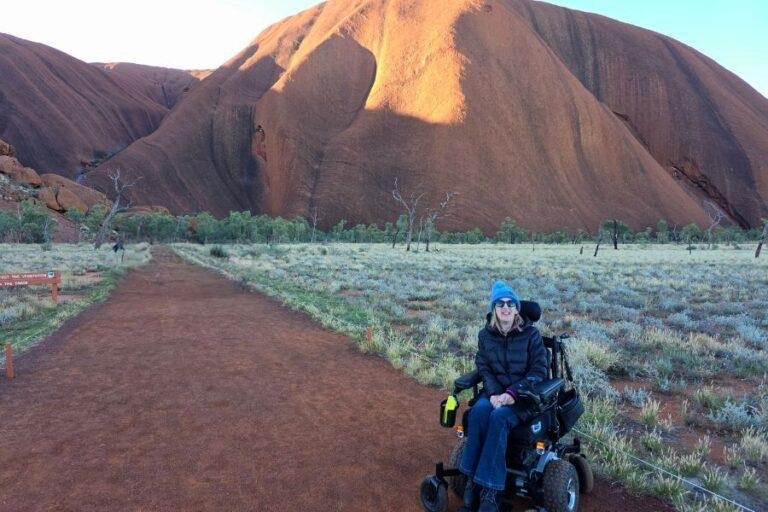

Uluru is made of sandstone about half a billion years old. Standing 348 meters high (1,142 feet) with a circumference of 9.4 km, it is indeed huge! Uluru is particularly stunning around sunrise and sunset when the golden light makes the rock’s reddish colours come alive. Exploring Uluru in an electric wheelchair takes a bit more planning, but trust me, it’s worth every bit of effort (shout out my amazing travel agent at Flight Centre and my travel companion for helping my organise this trip)!
As you read this, keep in mind that for this trip, I used my Magic Mobility V6 Frontier powerchair that has some off-road capability with the larger mid-wheel tyres, which made navigating the various terrains around Uluru easier. I’ll do my best to describe the terrains in this blog, but trust your own judgment. Since Uluru is pretty remote, I recommend getting your mobility device serviced before you go to make sure it’s in good shape. Also, it’s a good idea to bring spare tyre tubes, tools, and a pump for any unexpected issues.
Accommodation
Ayers Rock Resort, located in Yulara about 20km from Uluru, felt like an outback resort town. The resort provided a wheelchair accessible van for airport transfers, which is only a 10-minute drive to the resort. There are several options for accommodation at the Ayers Rock Resort, including Sails in the Desert Hotel, the modern Desert Gardens Hotel, the self-contained one and two-bedroom Emu Walk Apartments, and the Lost Camel Hotel. There’s also a large campground with powered and unpowered sites and cabins. Sails in the Desert, Desert Gardens Hotel, The Lost Camel, and the Outback Hotel and Lodge all have accessible rooms available. I was unable to check all of them out, so you might have to give them a call to find out more. The reservations staff are incredible and really know their stuff. They are well-informed about all the facilities and are more than happy to help you find the best options to meet your access needs. I can’t emphasise enough how helpful and lovely the resort staff were during my stay. From the moment I arrived, they went above and beyond to ensure I had everything I needed. Whether it was offering assistance, providing useful tips, or simply making me feel welcome, the staff’s dedication to exceptional service stood out and made my stay unforgettable.
I stayed at the Sails in the Desert Hotel in a superior wheelchair accessible room, which also offered an interconnecting room option (though I didn’t need this, it’s very convenient if required). The doorway was wide enough for my powerchair to pass through easily, and the swipe card access was a big help since I find using a traditional key difficult. The room was designed with accessibility in mind, providing plenty of space to manoeuvre a wheelchair. It could be configured with either a king-size bed or two queen beds. When the beds were split, there was sufficient space between them for wheelchair transfers, and they could be pushed further apart if more room was needed.
The bathroom was spacious, featuring lever taps, grab rails, and a toilet with a backrest. The roll-in shower included a flip-down seat, a hand-held showerhead, and grab rails. Additionally, there was adequate room under the sink for wheelchair access, with towels conveniently located to the side of the sink at a lowered level. Although the shower tap was somewhat out of reach when seated on the shower chair, the bathroom overall was large, well-designed, and provided plenty of turning space. The room also included a bar fridge and tea/coffee making facilities.
Getting around the resort is easy, with level pathways and ramps throughout. There’s a free, wheelchair accessible shuttle bus that runs every 20 minutes, making stops at all the hotels, the town square, and the camel farm. The shuttle bus has a ramp that the driver folds down, but just a heads-up: if it’s not parked against a curb, the ramp can get pretty steep and might be tricky to navigate without some help.
In the Resort Town Square, you’ll find a bunch of cool spots like gift shops, cafes, an IGA supermarket, a ATM, car hire, a news agency, a hair salon, a post office, and a Tour & Information Centre. It was about a 5 minute walk from Sails in the Dessert along a flat pathway.
I also checked out one of the Uluru lookouts right in the middle of the resort. There’s a compacted dirt track, but the last part is pretty steep and on soft sand. I probably pushed my powerchair a bit too hard and ended up getting slightly bogged down in the soft sand. Luckily, with a little push from behind, I got out and made it to the top. The views were amazing, but I wouldn’t recommend it unless you’re up for a bit of a challenge!
Transport
Exploring Uluru can be done by rental car, personal vehicle, or tour company. Wheelchair accessible rental cars were unavailable during my visit. It’s unclear whether this was due to a lack of availability at the time of my travel or if these companies simply do not offer wheelchair accessible vehicles in Uluru. There are three car rental companies in the area: Avis, Hertz, and Thrifty. There is also a hop-on hop-off bus that takes you out to Uluru and Kata Tjuta, but these buses are not wheelchair accessible unless you are able to traverse 2-3 steps to get into the bus. My preferred option for this trip was with organised tours.
Experiences and Tours
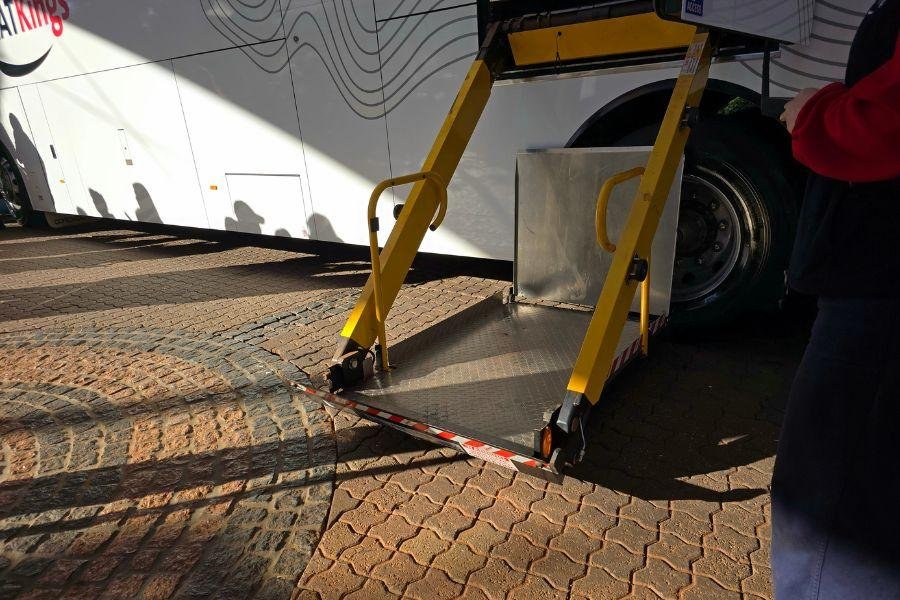
There are several tour companies operating in Uluru, but AAT Kings was the only one that offered a wheelchair accessible bus where I could remain seated in my powerchair during transportation. You just need to contact them well in advance to fill out their “Particular Needs Form” and arrange tours. They have two buses with lifts—a big coach-style bus and a smaller van—that can be adjusted to fit wheelchairs. AAT Kings offers a variety of tours, many of which are accessible with some advance notice.
Accessible Tours I Enjoyed
Field of Lights and Uluru Sunrise:
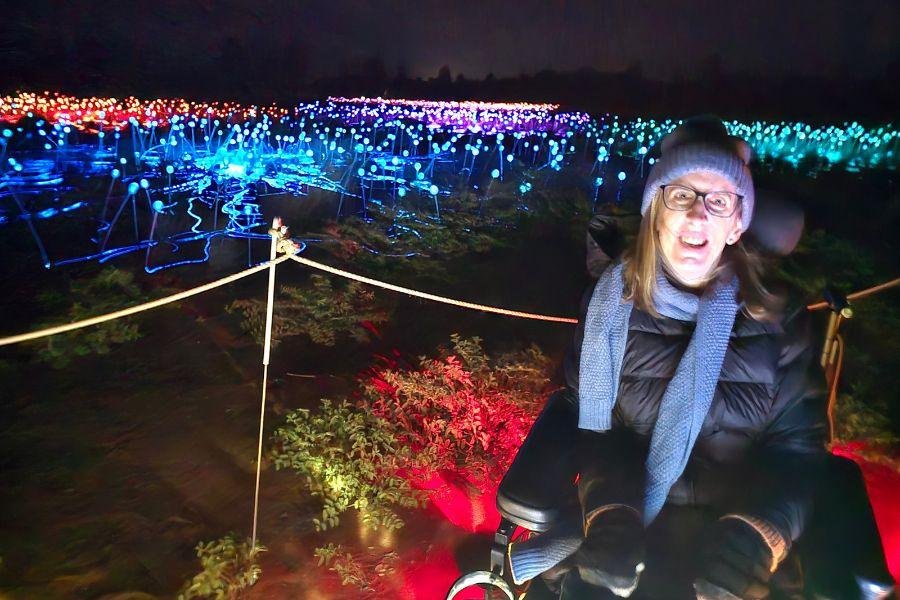
Seeing the stunning light installation and watching Uluru come to life at dawn was magical. I was transported in AAT Kings’ wheelchair accessible van, which took me to a different, more accessible entry point that was flatter and easier to navigate. There is a wheelchair accessible toilet at this entry point as well. This alternative entry point avoided the sand dune entry to the field of lights that the coach went to. The walk within the field of lights itself is completely flat, consisting of a compacted dirt/gravel track. However, since it was dark, a small torch was handy to spot any dips or bumps. After exploring the lights, it was back in the van and the driver transported me to the pathway leading to the sunrise viewing area, located right above the light installation. This is the portion that will be the trickiest part as there is an incline to reach the viewing area, but the ground cover is compacted gravel/sand with some small rocky bumps.
Uluru Sacred Sites and Sunset:
Discovering the sacred sites around Uluru and enjoying a breathtaking sunset was a highlight. This tour was done in AAT Kings’ wheelchair accessible bus. We first travelled around the base of Uluru in the comfort of the bus where the wonderful driver guide provided details on its incredible history, Aboriginal stories that go back many thousands of years, the significance of ancient Aboriginal rock art, the area’s flora and fauna, and the culture of its traditional owners, the Anangu. I wish I could transcribe word-for-word some of these stories because they were just incredible to listen to!
We then visited the Uluru-Kata Tjuta Cultural Centre, a place where I could easily spend hours. It’s compacted gravel/sandy track to get to the Cultural Centre and the inside is accessible with concrete pathways and had an accessible bathroom. There are no photos allowed inside the Cultural Centre or at various sacred sites around the park.
The next stop was to take the popular & short Kuniya Walk to the Mutitjulu Waterhole. We went inside the Mutitjulu Cave – a “family cave” – to view its ancient rock paintings. For many generations, Anangu families camped here. We then continued our walk to the Mutitjulu Waterhole, one of the few permanent water sources in the area.
The final stop before sunset was the Uluru bus sunset viewing area, known as ‘Sunset Strip.’ There are a couple of sunset viewing areas along this strip, but we went to the one designated for tour buses. The viewing area is on compacted sandy ground which is level. There is limited seating available, so I recommend bringing a fold-up camp chair if needed. We relaxed with a glass of wine and some nibbles as the sun set over the western horizon. It’s definitely special watching the changing colours of Uluru at sunset.
After sunset, we travelled to an exclusive site within the Uluru-Kata Tjuta National Park, set amongst red sand dunes and desert oak trees, for a delicious barbecue dinner. The dining area was all flat and concreted, so very accessible. The amazing conversations around the table with fellow travellers were the perfect end to the day. The guide then conducted a tour of the night sky, describing and pointing out some of the visible constellations.
Kata Tjuta Sunset Tour:
This tour took us to the inspiring red-hued sedimentary rock domes of Kata Tjuta (the Olgas) to watch the sunset. The Kata Tjuta sunset viewing area is only a short walk from the car park and wheelchair accessible along a compacted gravel/sandy pathway. There are some seating benches and sheltered picnic areas, but again I would recommend bringing a fold-up camp chair if needed. There are toilet facilities available here which are level to the ground, but no designated wheelchair accessible toilet. We relaxed with a glass of wine and some nibbles as the sun set, each passing minute bringing something new as the domes continued to change colour with the setting sun.
Sounds of Silence Dinner:
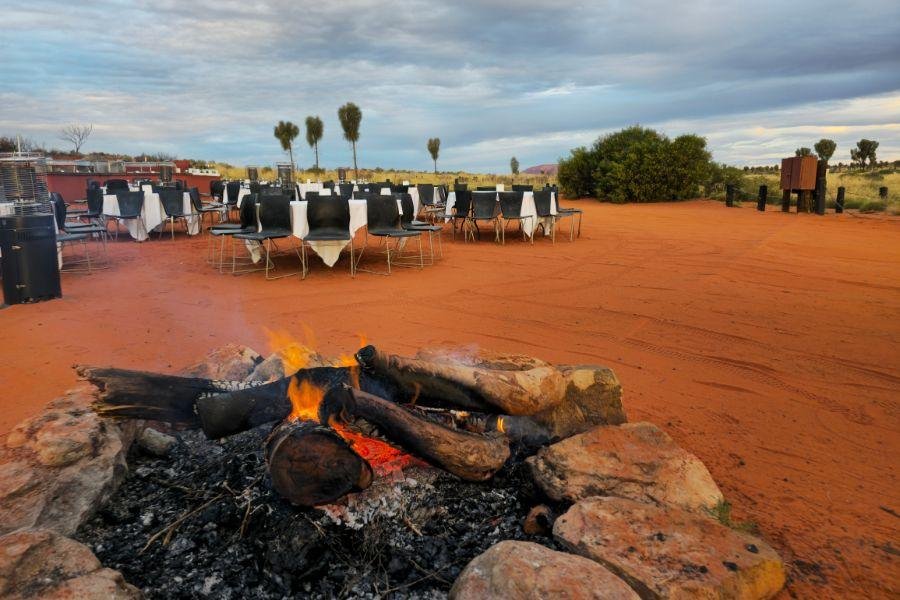
I booked the Sounds of Silence Dinner through Voyages. For this tour, I was transferred in a wheelchair accessible van instead of the bus since the sunset viewing area was atop a sand dune. We were dropped off where the dining area was set up, yet we still enjoyed spectacular views of the sunset over Uluru, with the sky painted in pinks and purples. The dining area was on a sandy, compacted surface suitable for most wheelchairs. Upon arrival, I was greeted with canapés and wine and had the opportunity to watch the breathtaking sunset before the other tourists arrived from the viewing area. It was quite pleasant to have the area to myself for a while!
After the sunset, we were seated at outdoor tables, entertained by a didgeridoo player, and served drinks and a buffet dinner. Despite it being winter and around 10 degrees when the sun went down, there were plenty of outdoor heaters and a large fire pit to stand around and stay warm. It was a stunning setting to enjoy a good meal with the lovely company of fellow travellers.
Uluru Base Walk:
I achieved my epic goal of wheeling the entire base of Uluru! The sheer size and beauty of Uluru are breathtaking. Each turn offered a new perspective of the rock, with its unique textures and colours, and the changing landscape. For the Anangu, the traditional custodians of Uluru, it holds great significance. Many of its features are part of their law and creation stories, known as ‘Tjukurpa’.
This 10.6 km track circles the entire Rock and took me about 3.5 hours to complete, with several stops to admire the surroundings. Starting at the Mala Car Park, the walk follows the path of the Mala people. From there, we continued to the North-east face walk, the longest open stretch of the Uluru base walk, extending from Kitchen Cave on the Mala walk to Kuniya Piti. Photography is prohibited here due to its sacredness, as it is believed to house a special spirit whose story cannot be seen elsewhere.
Next was the Kuniya walk, which runs from the Kuniya car park to Mutitjulu Waterhole, a lush and shady area different from the previous section due to the presence of water. The Lungkata walk connects the Kuniya walk with the Mala Walk and is one of the most geologically impressive sections of the Uluru base walk. Here, Uluru’s sides slope down to meet the path, with caves and crevices carved by years of wind and water erosion.
Back at the Mala carpark, I completed the 10.6km loop! I was exhilarated! Achieving this goal was significant (even though technically I didn’t ‘walk’ it – kudos to my electric wheelchair and my amazing travel companion), and I couldn’t help but feel a sense of accomplishment and gratitude. Moments like these remind me of the importance of accessibility in tourism, ensuring that everyone, regardless of their abilities, can experience the wonders of our world.
Track accessibility….I found the track to be well-maintained, with compacted dirt paths most of the way round, with a couple of footbridges and concrete paths at rock art viewing areas, making it easy to navigate. The track is relatively flat with only a few gentle inclines and declines, resembling more of a smooth speed bump than anything too challenging.
Rather than tackling the full base walk, there are smaller sections of the base walk that can be done individually, depending on your time, fitness level, and daily weather conditions. The Uluru-Kata Tjuta National Park website provides descriptions of the different walks. Most of the tracks are wheelchair accessible and range from easy to moderate.
- Sections of the base walk (clockwise direction):
- Mala walk (2km return)
- North-east face walk (longest section of walk)
- Kuniya walk to Mutitjulu Waterhole (1km return)
- Lungkata walk (4km return)
- Liru walk (not part of the base walk, but links the Mala car park with the cultural centre).
There are only two toilet blocks around the base walk, and these are not accessible (stairs leading up to the drop-toilets). One is located a short walk from Mala Car Park, and another at Kuniya Piti. The only wheelchair accessible toilet facilities are at the Cultural Centre (not on the base walk).
Be sure to drink water, wear sun protection, and in hot weather, plan to walk only in the morning hours when it’s cooler and finish before 11 am. There are two water tanks located on either side of the track, one at Mala car park and another at Kuniya Pitu. There are four emergency radio alarms located along the Base Walk in case emergency medical care is needed. It’s worth noting that there are several sensitive sites along the Uluru Base Walk where photos and videos are not permitted. These are well signposted and should be respected at all times.
Lastly, please make sure that if you are using a powered mobility aid, the battery is charged and capable of making the distance. The last thing you want is to run out of power halfway!
Other Experiences:
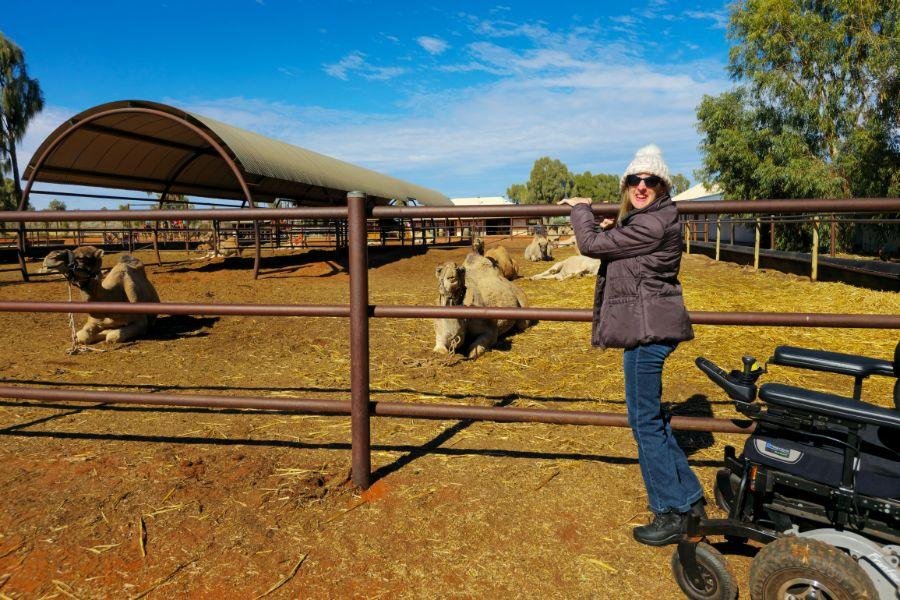
Ayers Rock Resort has some awesome free activities, like didgeridoo workshops and bush yarns where you can learn about Aboriginal culture and traditions. There is also a daily gallery tour at the Gallery of Central Australia (GoCA) located adjacent to Desert Gardens Hotel. The resort provides you with a list of free activities on arrival and they are also listed on the website. My trip would not have been complete without a visit to the Camel Farm, which is just a quick bus ride away on the resort shuttle. The farm is home to over 60 camels and a few other farm animals, all rescued from the wild. While I did not go on a camel tour, I enjoyed exploring the saddlery and the animal farm.An Unforgettable Experience
Exploring Uluru was absolutely unforgettable! It did take some extra planning and effort, but the accessible facilities and awesome service from Ayres Rock Resort and AAT Kings made it totally worth it. The sunrise and sunset views were stunning, and the cultural tours were deeply enriching. Every moment at Uluru was unique and awe-inspiring, making it an amazing experience overall.